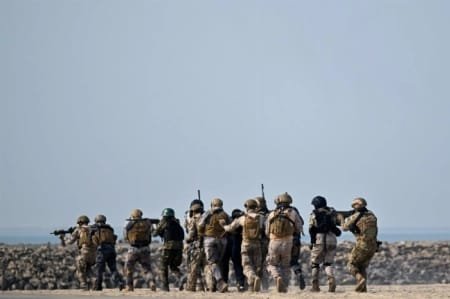
The joint naval exercise known as Red Wave 8 reached its conclusion at the King Faisal Naval Base, where the Western Fleet is headquartered, bringing together an extensive lineup of military and security leaders. Senior officials from Saudi Arabia and partner nations gathered during the closing ceremony, including the Chief of Staff of the Royal Saudi Naval Forces, Lt. Gen. Mohammed Al-Ghuraibi, and the Director General of the Border Guard, Lt. Gen. Shaya Al-Wadaani. Their presence underscored the strategic weight the Kingdom attaches to collective maritime preparedness and the safeguarding of the Red Sea region, a corridor vital for global shipping and regional stability.
This year’s edition of Red Wave brought an even broader and more diversified form of cooperation. The drill was planned and conducted under the command of the Royal Saudi Naval Forces, but its scope extended far beyond a single branch. Saudi Arabia’s land and air forces took part alongside the Ministry of Interior’s Border Guard units. Moreover, naval forces from across the Red Sea basin — including Egypt, Jordan, Djibouti, Sudan, and Yemen — joined the operations, reflecting a growing sense of shared responsibility over maritime security, counter-smuggling operations, anti-terror efforts, and the protection of international sea lanes.
Throughout the exercise, participating vessels, aircraft, and personnel engaged in a wide range of complex and technically demanding missions. Anti-submarine warfare was tested under conditions that mirrored real regional threats, with ships using sonar, surveillance systems, and coordinated tracking techniques to neutralize simulated underwater targets. Electronic warfare units tested their ability to disrupt hostile signals and protect their own systems from interference, while surface and air defense teams practiced intercepting fast-moving threats approaching from different directions. Live-fire drills were carried out using advanced weaponry, giving crews hands-on experience in destroying surface vessels and aerial targets under time pressure and battlefield-like conditions.
The maritime components were only one part of a much broader operational environment. Teams also implemented land and coastal scenarios specifically designed to test their tactical responsiveness. Amphibious landing crews practiced securing beachfronts while under simulated enemy observation, and urban-combat units moved through mock environments resembling complex littoral towns found along the Red Sea coast. Coastal-defense elements rehearsed how to repel hostile attempts at breaching sensitive zones. Special forces executed reconnaissance missions, precision raids on coastal installations, and operations patterned on real counterterrorism demands, including the rescue of mock hostages and the neutralization of heavily guarded threats. Mine-clearance teams demonstrated their ability to locate, defuse, and safely dispose of naval mines and unexploded ordnance — skills that are critically important in waterways used daily by commercial vessels.
Supporting these missions from above were naval aviation assets, including the MH-60R helicopters, which carried out live-fire strikes on designated sea targets. Meanwhile, ground units from multiple countries handled small-arms and medium-arms firing drills, ensuring that all participants, regardless of branch, gained operational familiarity with a range of weaponry. This integrated approach allowed units from different national forces to work in unison, practicing real joint operations rather than isolated or single-branch maneuvers.
Rear Admiral Abdullah Al-Anzi, who oversaw the exercise, emphasized that the results were precisely what the participating nations aimed to achieve. He highlighted the enhancement of combined deterrence capabilities, particularly against unconventional and irregular maritime threats that have become more common in modern conflict zones. He also noted that Red Wave 8 strengthened coordination in sharing intelligence and security information — a critical factor in preventing regional instability and ensuring that the Red Sea remains a safe corridor for economic activity. The experience of working together under conditions simulating real combat, he said, helped unify operational concepts among the participating forces, ensuring that they can respond collectively and coherently to emergencies, natural disasters, piracy attempts, or armed aggression.
Strategically, the exercise feeds into a wider security vision held by all participating states. The Red Sea forms one of the world’s most vital maritime highways, linking global markets through the Suez Canal and supporting the movement of millions of tons of goods each year. Cooperative exercises like Red Wave not only improve military readiness but also demonstrate a shared political commitment toward protecting this route from transnational threats, organized crime, and the broader geopolitical challenges that often affect the region. The presence of multiple nations working side-by-side sends a message that stability in these waters is a collective priority and that countries bordering the Red Sea are actively expanding their capacity to protect it.
In essence, Red Wave 8 became far more than a technical drill; it evolved into a platform for building trust, exchanging expertise, and strengthening the fabric of regional security partnerships. Through days of intense operations, realistic combat simulations, and joint strategic planning, the participating forces sharpened their readiness for real-world deployments. The exercise reaffirmed that in an era of rapidly shifting threats, collaboration — not isolation — remains the strongest guarantee of maritime stability and regional security.