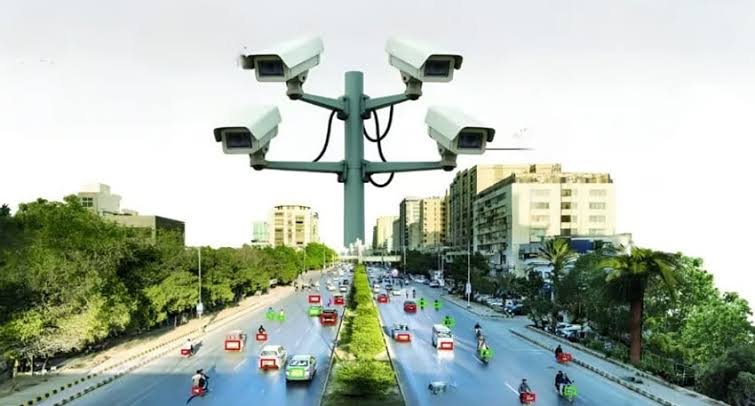
In a bustling metropolis like Karachi, where millions of vehicles move through the streets daily, enforcing traffic laws has always been a daunting challenge. Yet, the situation is now changing — the introduction of the E-Challan system, an automated digital traffic monitoring network, is beginning to reshape the driving behavior of citizens in a noticeable way.
According to Karachi’s Deputy Inspector General (DIG) of Traffic, Pir Muhammad Shah, the implementation of the E-Challan system has brought about remarkable improvement in traffic discipline. He stated, “Most people now wear helmets, signal violations have almost disappeared, vehicles stop before the line, and over 90% of drivers are using seat belts.” Pir Muhammad Shah explained that although the system is still in its early stages, the behavioral shift it has caused among citizens is extraordinary. People now realize that violating traffic laws means being caught on camera — there’s no escaping the digital eye.
The E-Challan system is based on an Automated Number Plate Recognition (ANPR) and video surveillance mechanism. Advanced cameras are installed at key intersections, highways, and traffic signals, capable of identifying vehicle numbers, location, time, and the nature of the violation. All this data is transmitted to a central server, where the system automatically generates a traffic ticket. According to Pir Muhammad Shah, over 10,000 challans have been issued so far, and only two or three cases showed minor technical discrepancies. Before issuing any challan, a trained officer manually verifies the license plate information — for instance, if the camera misreads the digit “1” as “7,” it is cross-checked by a human operator to prevent any wrongful fine.
The DIG noted that the most significant behavioral improvements have been seen in the use of helmets and seat belts. Previously, most motorcyclists rode without helmets, but now the majority consider it an essential safety measure. Similarly, traffic signal violations have drastically declined. Interestingly, since the system’s launch, drivers have started stopping before the designated stop line without being prompted, and traffic police rarely need to intervene directly for on-site fines.
The new system not only automates fines but also offers citizens the opportunity for discounted payments. According to Pir Muhammad Shah, if a driver clears the fine within 15 days, they can avail up to a 50% discount. He advised citizens to “buy a proper helmet worth 1,200 rupees instead of paying a 2,500-rupee fine — it will serve as permanent protection.” Another thoughtful feature of the system is that the first challan is waived for everyone, giving citizens time to learn and adapt. However, if a vehicle commits 10 violations in a single day, only one fine will be issued, while the remaining nine will be marked as warnings.
Pir Muhammad Shah clarified that if someone has sold their car or motorcycle, they can visit Excise or NADRA e-Facilitation Centers for biometric verification to remove their name from the registration and update the new owner’s CNIC details. He further explained that if a challan is mistakenly issued for a sold vehicle, the citizen can seek assistance at any of the 11 facilitation centers established across Karachi, one in each district.
The DIG also emphasized that using fake or decorative number plates is not merely a traffic offense but a criminal act. This matter is handled by the Safe City Authority, which immediately files an FIR once a fake plate is verified. Citizens have been advised to keep their number plates clean and clearly visible so that cameras can recognize them easily. Until government-issued standard plates are available, drivers may use temporary but accurately sized substitute plates.
Pir Muhammad Shah highlighted that government vehicles are not exempt from the system. If any official vehicle violates traffic laws, the challan will be issued in the name of the department head. If the fine remains unpaid for 21 days, the vehicle will be impounded. This measure is seen as one of the system’s most transparent and revolutionary features, ensuring accountability even within state institutions.
He also issued a stern warning to Chingchi rickshaw drivers, urging them to change their reckless behavior or face strict restrictions on their movement. He announced that soon, these rickshaws will also be brought under the E-Challan system, and any driver carrying passengers without observing safety protocols could be fined up to 15,000 rupees.
Pir Muhammad Shah proudly claimed that the E-Challan system is designed to be corruption-free. “No officer can cancel or reduce a fine,” he said. “All records are computerized, and no unauthorized person can access the data.” He also revealed that the government is considering introducing a community service-based policy, under which a portion of the fine may be waived if an offender engages in social service.
The enforcement of the E-Challan system in Karachi marks the beginning of a new era of civic discipline. While modern technology is reshaping public behavior, it is also reinforcing transparency and the rule of law. This initiative is not just about collecting fines — it is about raising public awareness and fostering responsibility. If this momentum continues, Karachi could become the first city where following traffic rules is not driven by fear, but by habit.